
What Our Recent Trip Revealed About Tech for Protecting Our Sacred Spaces
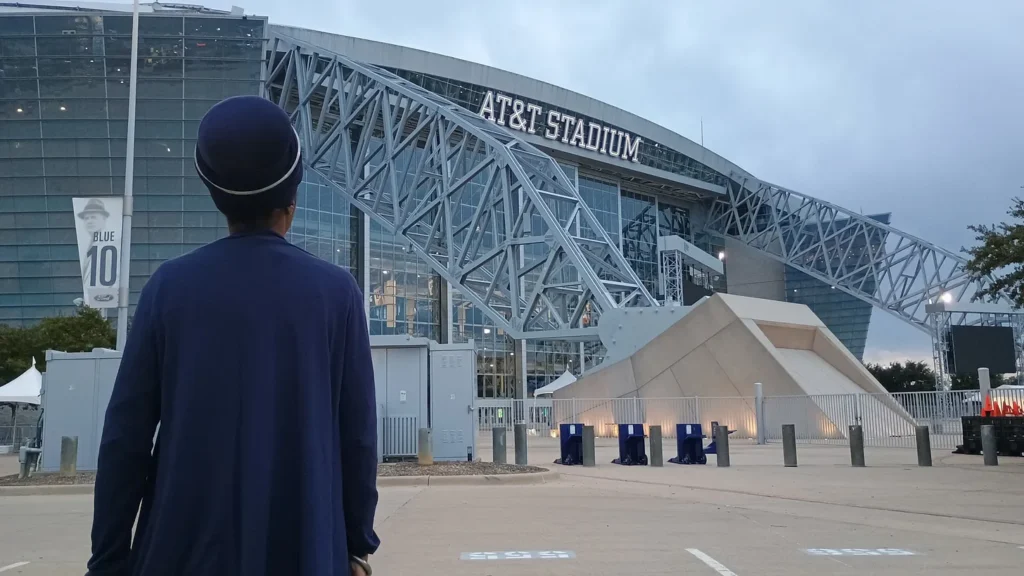
Saturday, November 1st – There are several words and images that come to mind when someone mentions the AT&T Stadium. The [Dallas] Cowboys, the National Football League, Jerry Jones, the games, cheerleaders, and the pageantry of what is American football. A security summit though? Very unlikely.
The reality is that the Cowboy Stadium has now hosted not only one, but two Security Summits. The most recent event (which occurred on October 15th) was free to all interested public.
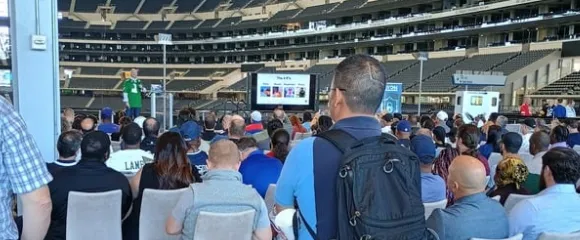
Amongst the attendees gathered that Wednesday morning were locals from a variety of industries & professions. Security consultants, security professionals, past and present military personnel, law enforcement, K-12 administrators, and K-12 educators. A quick look around made it apparent that besides myself, there were no other visible religious minority members present at this gathering (nor clergy members such as orthodox rabbis or Muslim Imams for that matter. Nevertheless, being the “first” or only is a common occurrence at these sort of occasions, but on the bright side, it’s another opportunity to present our community & its issues to org. leads who might otherwise have never been exposed. Who (like us) have a heart for protecting the innocent from others who wield bad intentions.
That morning while passing through security, this trip’s mission was at the forefront of mind. Not just to observe, but to discover technology, tools that could empower members of our community to protect themselves before hate turned into harm.
The Genesis of A Question
When the shift to becoming the Sikh Civil Defense Association occurred just a few months ago, the decision was made to focus on taking a proactive approach toward educating Sikhs on how to protect their personal well being in a variety of situations. The social media algorithm & mainstream (Sikh) news coverage made it appear that transnational repression & individual hate crimes were the only big issues of the day which needed to be addressed. That presumption was challenged though when we recently surveyed fellow Sangat members who follow & support our content about what they would like covered if there were to be a seminar in the future. Out of those community members who participated (which was a good enough portion), an overwhelming 80% voted that they wanted to learn more about protecting Sikh spaces. This was in opposition to protecting Sikh advocacy (which received one vote) and protecting Sikh identity (which received almost 20% of the vote). These poll results were not just an indication of where the minds of people within this organization’s community currently are, but also demonstrates where the hearts of the people truly lie. In protecting our Gurdwarai. In protecting the immediate areas around our Gurdwarai. In protecting the Sangat coming to and from the Gurdwarai. If this was a priority for them, then ਵਾਹਿਗੁਰੂ ਜੀ, this would be a priority for us.
From that day forward the question the organization sought to address shifted from “How can we prepare Sikhs in the US and Canada to be resilient and navigate a variety of challenges?” to “What formal structure of services can we provide to assist the Sikh congregations in creating safe spaces in & around our Gurdwaras Sahibs for guests and Sikh devotees?” This was the question I arrived with when I made my way to the first table.
Protection From the Air
Upon sight of the first table, my interest instantly peaked. Besides the handouts neatly displayed in front of me, I was ready to engage the guy standing behind the table with my initial questions. Unfortunately, someone else was also really intrigued before I arrived there, keeping the rep occupied for a long duration of time. So I gathered up their leaflets with the intention to return later.
Moving on to the next vendor, a young guy stood behind the table talking to another in front of what appeared to be a demonstration drone. While quietly listening to the ongoing conversation between the two, my eyes were drawn to a video playing alongside the drone. There appeared to be a bald middle-aged male armed with a rifle walking around an empty college lecture hall (a chilling sight for Americans who’ve been through plenty of school shootings). The drone whizzed around the man (in this case, actor) until it was right in front of him, placing a red box on the rifle. His facial expressions gave off a sense of annoyance at this contraption. I on the other hand, didn’t quite understand what I was watching and how this is any different from your average drone on the market.
As the vendor finished his previous conversation, there was finally a chance to introduce myself. Leading with the tidbit that I had recently become a licensed remote pilot, I asked if he could give an explanation about the model & how it could help in an active situation similar to the one in the video. He explained that their current drone model could identify firearms through the use of AI technology and track active shooters in real-time. Additionally, the cameras enabled video feed to be transmitted to the appropriate authorities (including law enforcement). Its features wouldn’t conclude there though. Their upcoming model would be releasing in a year or two & would not only be able to do all the previous items described but disable the identified firearm as well. While he continued to explain, another guy had approached the table standing beside me and listening with intrigue.
While the vendor kept talking, an internal tinge of excitement manifested into outward verbal expressions of amazement from the both of us. A train of thoughts in my head began to run: “So what he’s saying is, a person could go into the diwan hall with the purpose of doing serious harm towards the Sangat and yet we’ll have the option to delete that individual & the firearm without having to directly confront them?! Amazing.” The friend who had found his way beside me (also a licensed drone pilot) was simultaneously impressed. Finally, it had gotten to the point where enough information was gathered to move on. Smiling, we shook hands, and I continued on my rotation around the room.
Notifying Congregations in Real Time
There were over 20+ exhibits and sponsors present at the Stadium, but in the interest of brevity, only those relevant to our organization’s question mentioned earlier. That means certain tech (such as the power outlet emergency activation and alert system) won’t be discussed in this article.
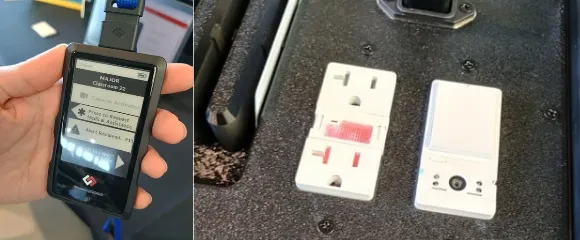
Caption: Vendor presenting Luminance by SWDGET, an emergency activation and response system integrated into everyday outlets.
Instead, I’ve chosen to highlight a tool that should be invested in and utilized every Sikh security or patrol team. Formal or informal.
The Share911 Application System
The main function of the Share911 application system is to communicate reported incidents via phone, computer, or other applicable devices to fellow organization team members. Team members are able to inform each other of the location & time of the incident, what the incident is, and the proper response needed. Particularly attractive about the Share911 system is the visitor pass option. Gurdwara attendees who are interested can enter their phone number after scanning a QR code and receive text notifications from the Gurdwara’s safety team. For example, if there’s a non-Sikh visitor smoking marijuana in the Gurdwara parking lot to watch 4th of July fireworks (true story), the team could choose to send out a notification that they’re addressing this issue in this location and to steer clear of the area until everything’s good. A feature some might appreciate is that all Sangat members and visitors who opt in for the visitor pass automatically have their number opted out at midnight the same day. This means, though, that you would have to add yourself back each time you visit the Gurdwara. Hopefully in the future there will be an option for those who want to stay opted in regardless.
Assessments and Team Training
After visiting all tables of interest, I sat down and caught the end of the panel on Physical Security. At its conclusion, I got up and made my way back to the one table I’d skipped at the very beginning of the summit. The Active Shooter Prevention Project. The same guy from before stood there, except this time, he was available to talk. We greeted each other, I shared that I had previously been by. He nodded and affirmed that he had seen me earlier but was preoccupied at the time. Now he was available to discuss what his organization had to offer. I told him about how our values as Sikhs usually influence the infrastructure & layout of our sacred spaces. While churches tend to have one main point of entry which congregants enter through during certain days of the week, the average Gurdwara Sahib has multiple points of entry with visitors rotating in & out throughout all times of the day everyday. He nodded, handed me his business card, explained how their organization comes and does assessments of institutions (including places of worship) to identify risks. Safety teams would need to be aware of these and ways to mitigate them. Their organization also provides formal training for teams at houses of worship (another necessary component for a sustainable Sikh security or patrol team). For newer/small organizations like ours who are looking for free or low-cost training, there also exists their non-profit wing, Asher360.
Closing Remarks
It was soon 12 pm, and though the summit lasted a few hours longer, obligations required me to make my exit. On the way out, besides dealing with the feeling of excitement of now having org reps to reach out for further collaboration, I couldn’t help but reflect on how blessed we are to live in a country where all of these resources exist for religious groups and institutions whose aim is to maintain peace in sacred spaces & the right to worship w/o interference.
In closing, we want to extend our heart felt gratitude to the Imron Corporation for hosting this necessary event. For all of us who care about keeping our Gurdwaras Sahibs safe and communities at peace— this gathering was a step forward in pursuit of universal Sarbat da Bhala.