
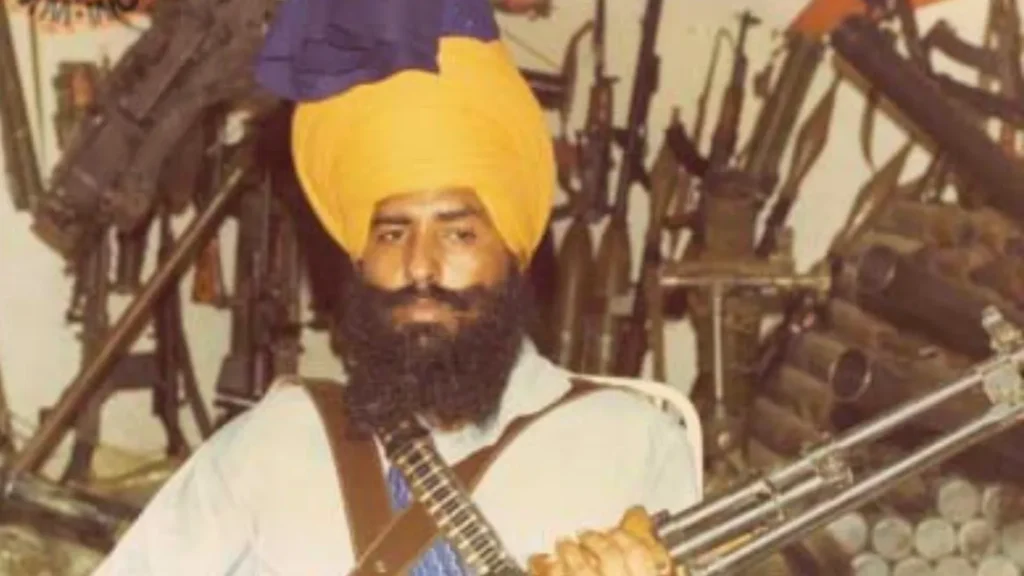
Reviving the Khalsa’s Military Legacy Series: Part 3
The Kharkus of the late 20th century deeply understood the essence of the Khalsa’s warrior spirit. This spirit was not born out of mere tradition, but forged in the fire of struggle, sacrifice, and a commitment to justice. It traces its origins back to 1699, when Guru Gobind Singh Ji revolutionized the Sikh faith with the introduction of Khande ki Pahul—the baptism of the double-edged sword. But why did Guru Gobind Singh Ji make this pivotal change, considering that the Amrit ceremony, known as Charan Pahul, had existed long before, dating back to the time of Guru Nanak Dev Ji?
To understand this monumental shift, we must look beyond the surface. The change from Charan Pahul to Khande ki Pahul was not merely a ceremonial transformation; it was a radical redefinition of what it meant to be Sikh. This is where we find the wisdom of Ratan Singh Bhangu, whose 19th-century work Pracheen Panth Parkash reveals the deeper vision of Guru Gobind Singh Ji.
‘Then the True Guru summoned and exhorted the Sikhs, “Hold weapons and defeat the Turks.”
Couplet: The Sikhs did not agree. They were afraid of the Turks. “They have a huge army. They are not likely to abdicate political power or to vacate the lands.”
Quartet: The Sikhs did not agree to the proposition: How can we get rid of the Turks? We are to the Turks what sparrows are to huge hawks or what sheep are to wolves. How can you make the deer kill the lion? How could the mountain stream water flow up the mountain?” These Mughals and Pathans are born soldiers and we are mere humble Jats, barbers, and carpenters. You have located all those who belong to the low castes. They are also disarmed. Call upon the Rajput kings; they will serve your purpose better.
Couplet: The True Guru regretted, “What have these Sikhs done? I desire to entrust political power to the Sikhs. They have refused it.”
Quatrain: The respected Guru was all-knowing. He discerned the real causes. The (prevailing) mode of initiation, drinking water touched by the Guru’s feet, inspires peaceful nature. It does not contain wonderful courage.
Couplet: They wear the saintly knotted woollen strings and humble caps on their heads. (A word meaning) slave is a proper name for them. Infinite compassion is a part of their personalities. It does not allow them to hold weapons.
Quatrain: Now the Sikhs must be physically transformed. They must exude power, and inspire fear. They must be given striking names. The form of initiation must sharpen them up.
This is what the True Guru decided upon and thoughtfully followed it up with action. A knight’s appearance, with long head hair and a turban tied on head, would look extremely handsome. Name ‘Singh’ was in the tradition of knights. The respected Guru considered this to be best. In his mind, he decided upon initiation with the double-edged sword. “This will make the Khalsa determined to prevail. This is how they will acquire kingly habits and every individual in every saddle will aspire to kingship. Reeds must be beaten into steel, and the initiation with the double-edged sword will make them habitually hold the double-edged sword.”
This passage underscores the profound transformation Guru Gobind Singh Ji envisioned for the Sikhs: a shift from a community of peaceful devotees to a formidable, courageous force, united not just in faith, but in the resolve to defend their beliefs and their homeland. The transition from Charan Pahul to Khande ki Pahul was not a mere symbolic gesture. It was a deliberate, strategic act designed to instill unwavering strength, boundless courage, and a warrior spirit in the Sikhs.” By embracing this transformation, joining the Khalsa was no longer only an act of spiritual devotion—it became a commitment to stand firm in the face of adversity, to fight for justice, and to carry the mantle of protecting the faith with honor and valor.
Sadly, in today’s world, many members of the Khalsa, both male and female, have shifted away from this warrior ethos, returning instead to a more passive, spiritually-focused version of the Charan Pahul. This retreat from the original vision of Guru Gobind Singh Ji can be traced to several factors: the corrosive effects of British colonial rule, continued suppression and interference by the Indian government, and a growing detachment from the rich legacy and purpose that once defined the Khalsa. As a result, the core responsibility of defending the faith and standing up for justice has been diluted. The kirpan, once a symbol of courage and readiness, have been dulled, shortened, and relegated to a mere ornament, while the warrior spirit that once burned fiercely in the Khalsa now flickers faintly within most Amritdhari circles.
However, there is hope. The course of this trend is not set in stone—we can reclaim that warrior spirit. But in order to do so, we must first understand the nature of the challenges we face. The adharmic forces are ever-present, using their power to oppress the innocent and disrupt peace. To protect the Panth, safeguard others, and uphold justice, we must not only recognize the threats posed by these forces but also understand the weapons and tools available to us to defend what is right.
Addressing Modern Threats
According to the 2019 FBI data on homicide victims, there were 13,927 murders in total in the US. Firearms were the primary weapon, accounting for 73.7% of these killings (10,258 victims). Knives or cutting instruments were used in 10.6% of killings (1,476 victims), while personal weapons, such as hands, fists, or feet, were involved in 4.3% (600 victims). Other weapons made up the remaining percentage.
Statistics Canada, updated in July 2024, recorded 778 homicide victims. Of these, 37.1% (289 victims) were shot, 30.1% (234 victims) were stabbed, and 16.1% (125 victims) were beaten. These figures provide a clear picture of violent crime trends and are crucial for developing targeted public safety initiatives.
Both data sets highlight the gun as the weapon most commonly used in homicides in North America, followed by knives, and then personal physical force. As members of the Khalsa, we must ask ourselves: if we were faced with such violence, do we have the necessary tools to respond effectively? And beyond our own safety, are we capable of protecting those who rely on us—children, the elderly, and the vulnerable?
In light of these trends, I believe it is essential for every Khalsa to be equipped with at least three key items to effectively address these common forms of violence: a kirpan, a firearm, and a less-lethal alternative
The Kirpan (ਕਿਰਪਾਨ)
The kirpan is a kakaar that every Amritdhari is obligated to carry. It is not just symbolic; it serves as an instrument of the Divine’s mercy in the world, particularly in situations where it is lacking. This purpose can only be fulfilled if the kirpan is functional, consistently maintained, and kept clean.
Sadly, many kirpans distributed at Amrit Sanchars or sold in stores don’t meet this standard. There are two solutions to this issue. The first is to find and order kirpans from manufacturers who will custom-make a kirpan that is both Sarbloh and sharp. Most of these manufacturers can be found on Instagram or Facebook, but it’s best to ask around to ensure you’re purchasing from an authentic seller who does high-quality work. The second option is to purchase a sharpening stone, such as a whetstone, and sharpen it yourself.
For instance, I purchased mine from a local Gurmat store in Toronto, but when I got home, I had to use a knife sharpening stone to make it truly functional.
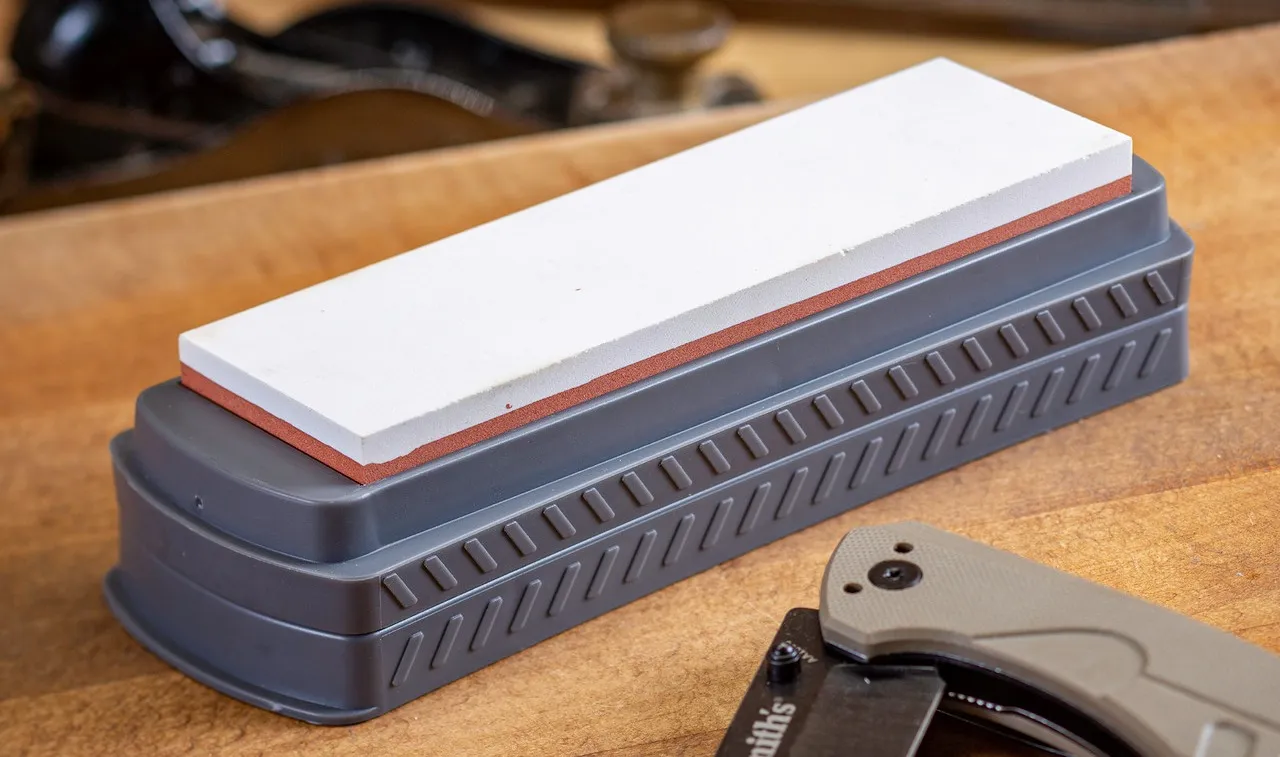
Smith’s 6″ DualGrit whetstone featuring 325 and 750 grits
The issue of size is also important. While the exact minimum size of a kirpan can be debated, it should be large enough to effectively serve its purpose of defense.1 What inspired me to wear a larger kirpan was reading about the jeevans of Bibi Amarjit Kaur, especially seeing photos of her from the early 80s, and learning the story of Shaheed Bibi Ravinder Kaur. This is the kirpan I strive to carry with me, except in certain situations, like at work.
Additionally, in the book Gurmat Bibek, Bhai Sahib Bhai Randhir Singh provides commentary on this issue, which I’ve included below:
“It’s commonly seen in todays Amrit Samagams that initiates are only provided with small kirpans to keep in their hair. Only in certain cases are initiates provided with full size kirpans, to fulfill the [kakaar] requirement [at the exact time of initiation] which are then removed and taken back [by the Amrit sanchar jatha]. Now does this automatically mean that the tradition of bearing a full sized kirpan does not have precedence within the confines of Gurmat?
…
Although in todays day and age, only a number of Singh’s firm in their Rehit keep a 12 inch long Gatra-Kirpan tied to themselves, that day isn’t far, where we Singh’s will see full sized kirpans adorned on all Khalsa Sikhs….
We are now clearly seeing that the once lost traditions of the Guru Khalsa Panth are seeing the light of day again! In this way will a new age come, where the once miraculous age of Guru Gobind Singh will again shine forth, in which committed Singh’s, firm in the supreme practise of Sarbloh will be found in the masses; Moving, Ruling, fighting, and Roaring!”
-Bhai Sahib Randhir Singh
Translated by Srimukhvaak from “Gurmat Bibek”, pg 218
The Firearm (ਅਸਤਰ, ਤੁਪਕ)
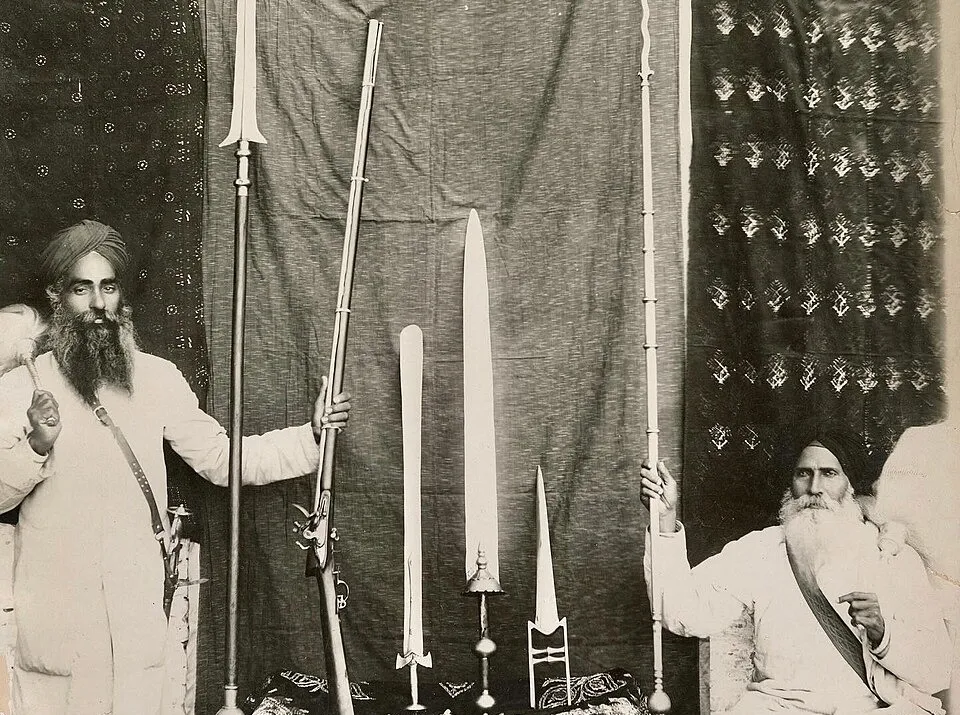
Weapons of Guru Gobind Singh on display at Takht Kesgarh Sahib (Anandpur Sahib), 1925. The second weapon from the left is a Jeejail (front-loading musket).
The firearm is a traditional shastar that has become increasingly relevant in today’s world. It is an essential tool used by military forces, law enforcement, and private security to combat crime and protect civilians. While some advocate for removing firearms from society to reduce incidents like mass shootings—an understandable position—the reality is that banning firearms does not eliminate their presence in the black market. Criminals will still trade, possess, and manufacture firearms through illegal means, and they will continue to use these weapons against law-abiding citizens. In a world where a criminal intent on harm is likely to wield a firearm, it’s wise to be prepared to defend yourself and those who follow dharam.
For those who are hesitant to own a firearm or are new to this world, I recommend enrolling in a local introductory handgun course through the USCCA. I’ve personally taken a variety of courses with them—from situational awareness to home defense fundamentals and handgun training—and have always walked away feeling satisfied.
For those residing in Canada, I recommend contacting Dasmesh Dynamics or reaching out to the relevant service provider in your province by clicking here to explore your options.
A Less-Lethal Alternative
One of the five core virtues of Sikhi is daya, which translates to “compassion.” Daya forms the foundation of righteousness and righteous living, guiding a Sikh to act with compassion in every aspect of their life.
When it comes to using physical force, daya teaches that the most compassionate solution should always be prioritized. If a situation can be resolved without resorting to lethal force, that path should be chosen. It is this compassionate mindset, coupled with restrictions on firearms in certain states, regions, and countries, that has led to the development of “non-lethal” or “less-lethal” weapons, such as tasers, pepper spray, stun guns, and batons.
While there are many options available, each with its own advantages and drawbacks, the one I personally recommend is the Byrna.

The Byrna is a legal, non-lethal self-defense option available in all 50 United States and all 10 Canadian provinces. It requires no background checks, permits, or licenses. Their product lineup includes a range of less-lethal pistols, rifles, various types of ammo (with some restrictions based on country), and accessories. Byrna products are not only available to civilians but are also used by law enforcement agencies across the country.
The Byrna SD (Self Defense) is the most popular less-lethal pistol in the U.S., known for its compact size and ease of use. It delivers moderate impact with a range of up to 60 feet and can hold 5 rounds, firing up to 22 shots on a single CO2 cartridge. This makes it a great option for personal protection.
The Byrna LE (Law Enforcement) Launcher is a more powerful alternative, typically used by law enforcement. It has a higher impact, faster firing rate, and can shoot up to 17 times per CO2 cartridge. While it’s still compact, it’s slightly larger than the SD model and also offers a 60-foot effective range. Both models are designed for non-lethal use, providing a safe and effective means of self-defense.
The Byrna LE (Law Enforcement) Canada kit includes the BYRNA Kinetic Energy pistol, which is a powerful, less-lethal weapon with a muzzle velocity of 330 feet per second and can shoot 18-20 rounds on a single CO2 cartridge. With a range of 60 feet, it’s a mid-sized, highly effective option. The Byrna SD Canada kit is a slightly less powerful version, shooting at 280 feet per second with a more compact design. It also offers 18-20 shots per CO2 cartridge and the same 60-foot range, making it a trusted choice for personal safety.
This is an excellent option for families, especially those with children, who may be concerned about keeping actual firearms in the home. However, please note that the Byrna can be mistaken for a real firearm, so it’s important to handle and travel with it responsibly.
Self Defense Law
It is crucial to understand that the irresponsible use of any of these defensive tools can lead to a courtroom, a conviction, and imprisonment—even if you were only acting in self-defense. This underscores the importance for anyone who is shastardhari to be well-versed in the legal boundaries surrounding the use of such tools, regardless of whether they choose to stay within those limits. The reality is that most Americans (and likely Canadians as well) are unfamiliar with the self-defense laws in their state or region, including those who are trained in firearms and other protective arts. This is where the five elements of self-defense law come into play.

“The Five Elements of Self Defense Law” Poster Available for Sale on LawofSelfDefense.com
The five elements of self-defense law were developed by the attorney Andrew Branca. Branca was inspired to begin researching this subject after friends asked him about self-defense laws, which had only been briefly covered in law school. He visited law libraries and conducted primary research on self-defense law in one state, then expanded his research to five states, and eventually all 50. As he delved deeper, he noticed a pattern—the same five elements appeared across all states. This led to his epiphany: the self-defense laws of every state shared a common framework that could be distilled into just five key elements that make it harder to convict someone in a self-defense case. These elements, when met, make it more difficult to secure a conviction in a self-defense case. However, Branca also realized that these elements are cumulative—meaning if any one of them is disproven by the prosecution, it can make the case much easier to win.
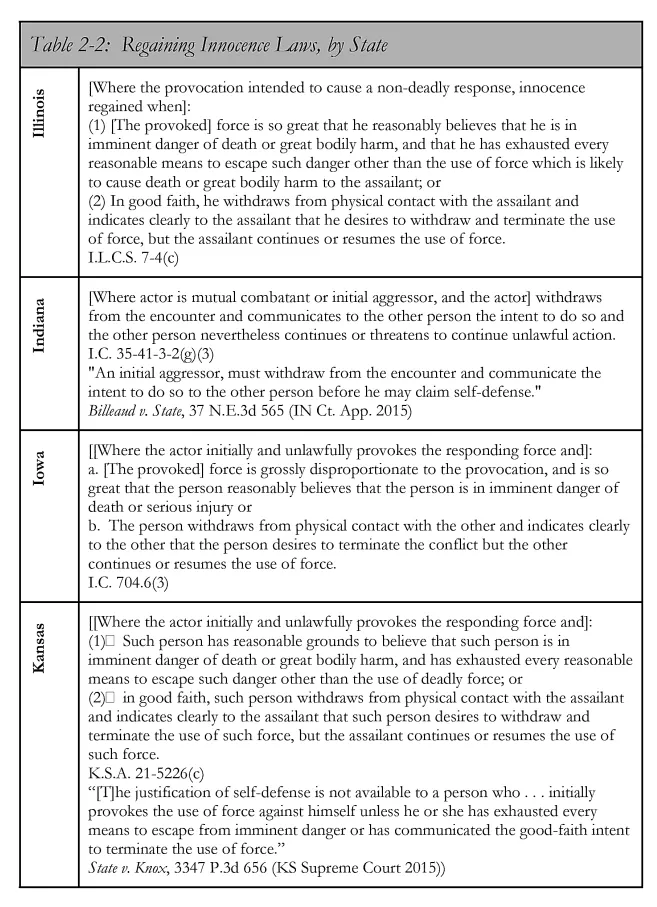
He also wrote a book titled The Law of Self Defense, which is available for order on Amazon. In it, there is special section dedicated to state-specific legal information. One screenshot from the sample is provided below.
Embracing More
While only three types of shastar were highlighted today, Sikhs should never limit themselves to just these. They should have access to a wide range of shastar and be proficient in modern warfare techniques, including the use of drone technology, artillery, and explosives. It is essential for the Khalsa to embrace and utilize every tool available to protect and uphold the principles of justice and dharam.
At programming held at our Shastargarh, all varieties of shastar will not only be welcomed but actively encouraged for both Singhs and Singhnia. In doing so, we reaffirm the tradition of being ever-ready to defend our faith, our community, and all those who stand for righteousness regardless of religious affiliation. My deepest hope is to see other Sikh spaces, especially Gurdwaras in the West, become more receptive to shastar and the true warrior spirit that Guru Gobind Singh Ji envisioned.

Sign for Display at the Outpost Encampment