

Analyzing the Role of RA&W in Countering Sikh Self-Determination and Presenting Effective Solutions
Author’s Note: If you’re a Sikh individual involved in political advocacy, human rights work, or simply seeking tools to enhance personal safety, a set of interactive tools and resources is provided at the end of this post. These may be especially useful for individual preparation or for sharing within your local congregation.
On June 28th, 2025, Parag Jain, a Senior Indian Police Service officer, was appointed by the Union Government of India as the chief of the Research and Analysis Wing (RA&W), the country’s intelligence agency. He officially assumed the position on July 1st, 2025, following the retirement of his predecessor on June 30th. Jain’s appointment has raised concerns among Sikh communities worldwide. His career began in 1989 when he joined the Punjab Police, where he was actively involved in combating the Khalistan movement. Jain became known for his involvement in human rights abuses during this period, including being named in the extrajudicial killing of Sikh dissident Sukhdev Singh in January 1993. This historical backdrop is significant in the context of the growing phenomenon of what is called transnational repression.
The Recent Trend of Transnational Repression
Transnational repression is when “governments [reach] across borders to silence dissent among diasporas and exiles, including through assassinations, illegal deportations, abductions, digital threats, Interpol abuse, and family intimidation.1
The U.S. Department of Justice gives this explanation of transnational repression.
Some foreign governments seek to intimidate and silence their citizens who are visiting or living in the United States. These governments may also target members of their diaspora who are permanent residents, naturalized or U.S.-born citizens, members of their family, or friends. These activities threaten U.S. sovereignty, violate U.S. law, and infringe on individuals’ rights and freedoms.
The leading perpetrators of transnational repression in the modern world include countries such as the People’s Republic of China, the Russian Federation (Russia), and the Islamic Republic of Iran. India has also been cited as a state that engages in such practices.
While it could be argued that the Government of India (GOI) has targeted political dissent, particularly from Sikhs, since the establishment of the Republic of India in 1947, the roots of this repression run deeper in the 1970s and 1980s. It was during this time that Sikhs began to heavily advocate for their own political autonomy, defying the authority of the central government. This led to an armed struggle that lasted until the mid-1990s.
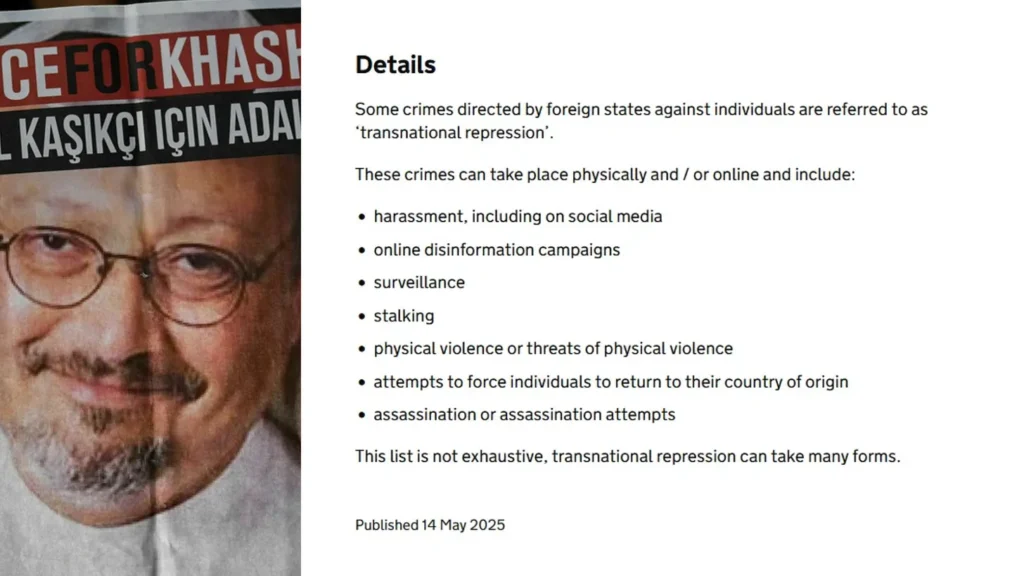
The conflict between the Government of India and Sikh separatist groups has not subsided. It has persisted over the years, extending beyond national borders and influencing Sikh communities in countries such as the United Kingdom, Australia, Canada, and the United States. With the resurgence of the Khalistan movement, levels of repression against Sikhs have reached heights not seen since the decline of kharkuwaad in the 1990s.
Indian Interference in North America
In the past two to three years, there have been incidents involving repression against the Sikh diaspora, some of which have not received significant attention. These include but are not limited to the seemly targeted drive-by shooting of a Sikh activist in Northern California, reports of surveillance and threats against a Sikh California Assembly member, and an incident in Surrey where a Sikh activist’s home and car were shot at. While these events have not attracted widespread notice, two particular incidents have garnered international attention.
The United States
Nikhil Gupta
Nikhal Gupta, an Indian national with prior involvement in international narcotics and weapons trafficking, was recruited by an employee of the Indian government to orchestrate the assassination of Gurpatwant Singh Pannun, the head of Sikhs for Justice and the Khalistan Referendum movement. Gupta contacted an individual he believed to be a criminal associate and arranged for another person to deliver $15,000 in cash to the hitman as an advance payment for the murder. Along with the payment, Gupta provided the hitman with Pannun’s home address, phone numbers, and details of his daily routine.
However, unbeknownst to Gupta, the hitman he hired was, in fact, a DEA agent, which led to the foiling of the plot. This development ultimately resulted in the Czech authorities apprehending and detaining Gupta on June 30, 2023, under the bilateral extradition treaty between the United States and the Czech Republic.
In October 2023, a second indictment was released by the U.S. Department of Justice, revealing that the Indian government employee responsible for orchestrating the plot was Yikash Yadav, a man from Haryana.
Yikash Yadav
The second indictment released by the FBI revealed that Yadav used the pseudonym “Amanat” when communicating with Gupta. It also provided additional details regarding his connections to the Government of India.
During times relevant to the second superseding indictment, Yadav was employed by the Government of India’s Cabinet Secretariat, which houses Indian’s foreign intelligence service, the Research and Analysis Wing. Yadav has described his position as a “senior field officer” with responsibilities in “security management” and “intelligence.” Yadav also has referenced previously serving in India’s Central Reserve Police Force and receiving “officer training” in “battle craft” and “weapons.” Yadav is a citizen and resident of India, and he directed the plot to assassinate the Victim from India.
Not much is known about him, aside from his physical characteristics and the pictures released by the Federal Bureau of Investigation.
The US Government’s Response
Currently, Gupta is being held at the Metropolitan Detention Center, while Yadav has been placed on the FBI’s Most Wanted List. Both men are facing serious charges, including murder-for-hire (which carries a maximum 10-year prison sentence), conspiracy to commit murder-for-hire (also carrying a maximum 10-year prison sentence), and conspiracy to commit money laundering (with a maximum 20-year prison sentence). Despite these developments, US-India relations continue as usual, with a primary focus on strengthening economic ties between the two nations.
Canada
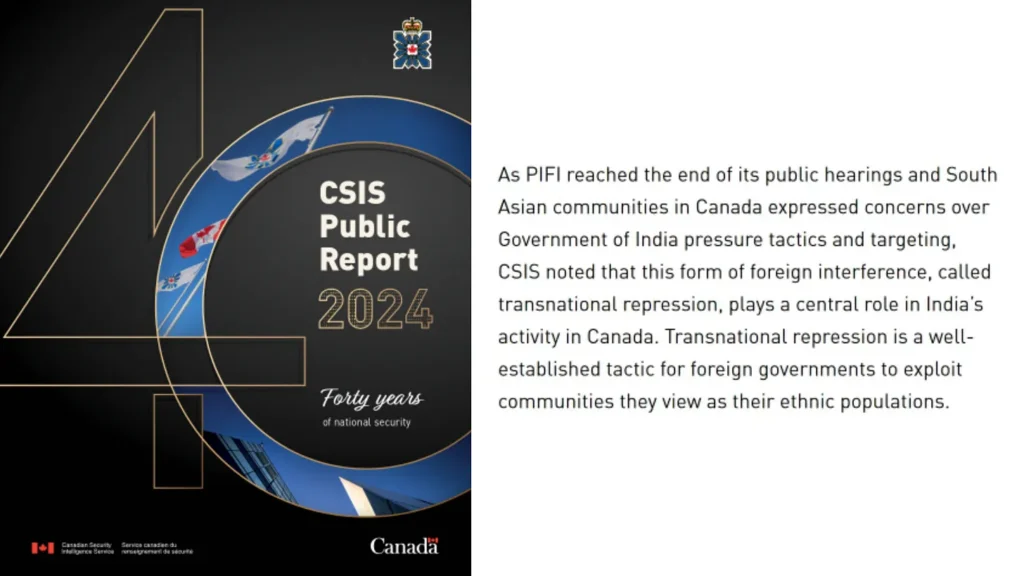
A section from Canada’s CSIS 2024 Public Report highlighting ongoing concerns about India’s activities within Canada
Canada has long been a key player in addressing political issues related to the Sikh community. Sikhs in Canada have consistently been at the forefront of advocating for Sikh rights, often challenging the policies of the Indian government. This activism has remained a thorn in the side of New Delhi. Since the 1980s, the Indian government has employed covert tactics, infiltrating Sikh media outlets and places of worship in Canada, aiming to shape public opinion, promote India’s narrative, and cultivate political allies within the country. However, it wasn’t until recent years that the Indian government escalated its approach, resorting to physical violence by targeting prominent Sikh activists.
In addition to their earlier strategies, the Government of India (GOI) reportedly now uses criminal networks to incite violence within South Asian communities in Canada.2 One such network is the India-based Bishnoi Gang, which has been linked to criminal activity conducted against these communities.
The Murder of Bhai Hardeep Singh Nijjar
The culmination of these tactics was seen in the murder of Bhai Hardeep Singh Nijjar, the president of the Guru Nanak Sikh Gurdwara in Surrey, British Columbia. On June 18, 2023, Nijjar, an outspoken critic of India and an advocate for Khalistan, was shot outside the Gurdwara in what appeared to be a targeted attack. The nature of the killing drew widespread attention, sparking concerns about the growing influence of foreign governments in Canadian and Sikh affairs.
The Canadian Government’s Response
In the wake of his murder, Canadian authorities arrested four individuals in connection with the crime, all of whom are now undergoing trial. All four men have been identified as Indian nationals. Canada’s Security Intelligence Agency acknowledged in its 2024 report that “links between the Government of India and the Nijjar murder signal a significant escalation in India’s repression efforts against the Khalistan movement and a clear intent to target individuals in North America.” During a news conference in October of last year, RCMP Commissioner Mike Duheme disclosed that the police had gathered evidence indicating that Indian diplomats and consular staff collected information and forwarded it to the Indian government, which then issued instructions to criminal organizations to carry out acts of violence. To disrupt the system between the Government of India (GOI) and criminal gangs residing in Canada, Canada expelled six Indian diplomats and consular officials in the same month, citing “public safety” concerns.
The Sikh community in Canada expressed surprise and deep disappointment when newly elected Prime Minister Mark Carney extended an invitation to Indian Prime Minister Narendra Modi to attend the 2025 G7 summit in Ottawa. Carney’s intention was to reestablish diplomatic ties between Canada and India in the interest of economic development. After the meeting between the two heads of state, a member of the media asked the Prime Minister whether he discussed this issue with Modi and advised him to stop it. “We’ve made our position very clear,” Carney said. “Including recently, that we will not tolerate transnational repression in Canada from any source, geographic or institutional.”
Counteracting Transnational Repression
The recent actions of the Government of India against Sikh activists and advocates for the establishment of Khalistan worldwide have highlighted certain vulnerabilities within the Sikh community. As a result, many individuals turn to the intelligence and security agencies of their country of citizenship for protection. However, the support provided by these agencies has been limited, primarily offering advice and warnings to high-risk individuals, who are often left to navigate these challenges on their own. If these issues are not addressed, they could potentially impact the functioning of the Sikh Quam, its efforts, and the integrity of sovereign Sikh spaces, including the Gurdwara Sahibs.
Community-wide education and awareness of foreign interference tactics in diasporic communities, along with effective strategies to counter these threats, are essential to ensure preparedness and the ability to address these challenges now and in the foreseeable future.
However, the concern does not end here. In the spirit of the Sikh principle of daya (compassion), it is important to support members of other communities who also face unjust opposition from foreign governments, as we continue to pray for universal justice and Sarbat da Bhala – the well-being of all. As we confront these challenges, we are reminded that bringing Khalsa Raj depends not just on upholding our own rights, but on collectively ensuring that these values are upheld for all, everywhere.
Tools and Resources
Official Federal Publications On Counteracting Transnational Repression:
- ProtectUK’s The Blue Book: A Guide to Personal Security ( Website | PDF )(Punjabi translation is available through the website under ‘Accessibility and Language Tools’ in the top right corner)
- The FBI’s Threat Intimidation Guide: English | Punjabi
- The CISA’s Resources Applicable to Counter Transnational Repression
- CSIS’ Foreign Interference and You
- CISA’s Personal Security Considerations Action Guide: English | Punjabi
Present and Past Federal Investigations into Transnational Repression:
- The UK Human Rights Joint Committee’s Inquiry into Transnational Repression: Written Evidence
Interactive Tools
- Create a customized digital security plan by answering questions the Consumer Report Security Planner
- For those wanting a more holistic security plan, sign up for the FreedomLab’s ecourse Managing Risks: Safety and Security in Human Rights Work
- Review and complete the attached Security Workbook. It is an excellent resource for individual preparation and group sessions alike.
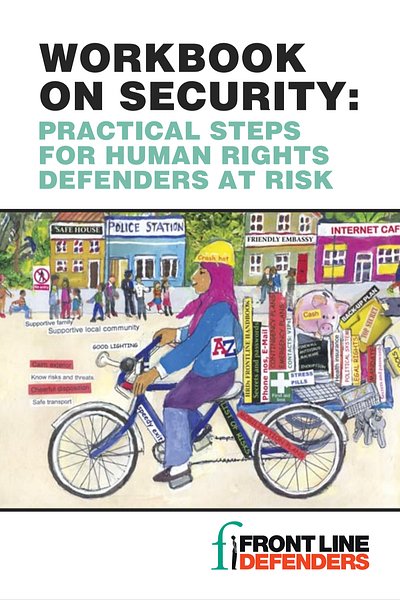
Workbook on Security: Practical Steps for Human Rights Defenders at Risk
Publication by Front Line Defenders: The International Foundation for the Protection of Human Rights Defenders
- https://freedomhouse.org/report/transnational-repression
- CSIS Public Report 2024